

The Practice & Multi-User Administration module serves as the operational command center of the DecisionDoc EHR ecosystem.
It empowers administrators, compliance officers, and executive teams to manage users, locations, and permissions across the entire healthcare network—all within a single, secure, and fully auditable environment.
Built on FHIR-based interoperability and reinforced by DecisionDoc’s patented algorithmic validation engine, this module ensures that every access event, record action, and workflow adheres to the HIPAA Security Rule, HITECH Act, and OIG Compliance Program Guidance.
DecisionDoc transforms administrative oversight into a proactive compliance discipline—merging efficiency, transparency, and data integrity in one unified interface.
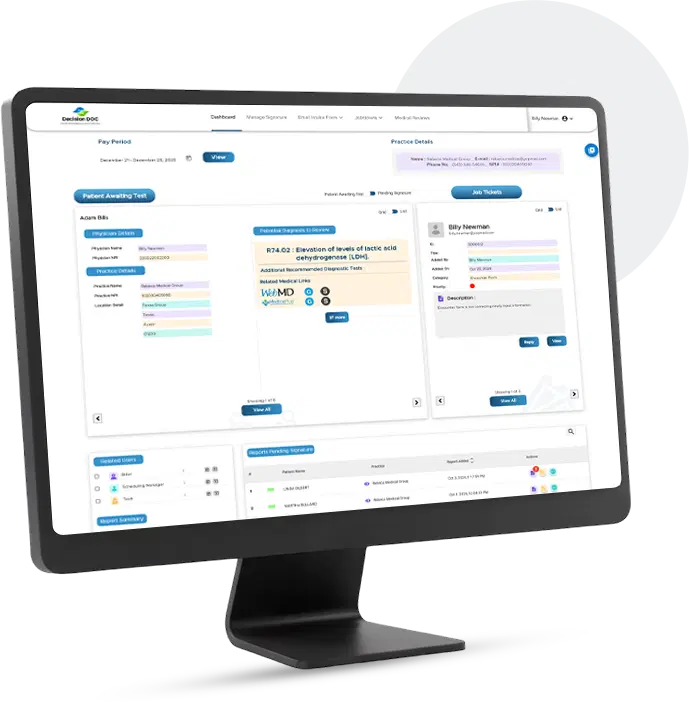
Each DecisionDoc implementation includes a centralized administrative dashboard that integrates every operational layer—providers, billers, schedulers, record managers, and compliance staff.
Administrators can visualize user activity, adjust permissions, and monitor workflow compliance in real time.
All user actions are verified and timestamped by the patented DecisionDoc algorithm, then stored as immutable FHIR AuditEvent entries, creating a verifiable chain of custody for every data interaction.

DecisionDoc’s multi-tenant architecture allows administrators to oversee multiple practices or departments through a single, secure login.
Each location functions as an independent logical entity within the network—maintaining PHI boundaries while contributing to a unified, algorithm-verified data model.

Multi-location patient and provider directories.

Cross-site scheduling, telehealth, and billing coordination.

Consolidated reporting across all branches.

Location-specific PHI segregation and access controls.

Centralized onboarding, credentialing, and lifecycle management.
All inter-location data transfers are encrypted, logged, and algorithmically checked for authorization and completeness—ensuring enterprise scalability without weakening compliance.

The DecisionDoc administration engine uses a validated RBAC matrix aligned with HIPAA’s “minimum necessary” principle.
Each role—Physician, Nurse Practitioner, Biller, Scheduler, Technician, or Administrator—has predefined permissions validated by the patented algorithm for conflict detection and privilege escalation control.
This structure minimizes insider-risk exposure while maintaining an audit-ready record of every authorization, modification, and policy action.

DecisionDoc’s patented validation engine continuously monitors and verifies that administrative actions conform to security and PHI-handling requirements.
Each event is logged with timestamp, user ID, IP, and location metadata in immutable FHIR AuditEvent format.
Logs are encrypted, algorithmically sealed, and retained for six years, satisfying HIPAA and HITECH retention mandates.

DecisionDoc provides administrators with real-time workforce analytics based on validated, de-identified datasets, ensuring compliance while enabling operational insight.
All analytics outputs are algorithmically validated to prevent PHI exposure.



Department-based message routing and escalation.

Task and ticket management for operational issues.

Broadcast announcements with acknowledgment tracking.

Optional encryption for policy and SOP attachments.
DecisionDoc includes a HIPAA-secure internal communication system that eliminates the need for external, unencrypted email exchanges.
Each message or attachment is encrypted, algorithmically verified for content integrity, and logged under the FHIR security infrastructure.
This ensures all internal communications supporting patient care or compliance remain within a controlled, auditable network.
The administrative suite continuously monitors staff credentials, certifications, and compliance training.
Each record is verified by the patented DecisionDoc algorithm for validity and expiration accuracy.
All credential data is encrypted, role-restricted, and retained under HITECH §13411 guidelines.


Annual third-party risk assessments, penetration testing, and documentation reviews maintain DecisionDoc’s compliance readiness and certification.

DecisionDoc’s cloud infrastructure supports networks of any size—with horizontal scaling, load balancing, and algorithmic monitoring to ensure uptime and data consistency across multiple locations.
Elastic performance and load adaptation.
Redundant data centers for failover continuity.
Secure FHIR replication for multi-region networks.
This architecture allows healthcare enterprises to grow without sacrificing compliance or control.
DecisionDoc’s Practice & Multi-User Administration module is more than a management interface —it’s a compliance and governance framework driven by patented algorithmic validation.
Every access event, policy change, and workflow adjustment is verified, recorded, and defensible.
Control. Visibility. Compliance. Confidence.
In a healthcare environment defined by regulatory precision, DecisionDoc provides transparency and assurance—helping organizations operate efficiently, lawfully, and securely across every level of their network.